Ailao (矮老): Short Struts Between Stretcher and Top
Short struts · 短柱
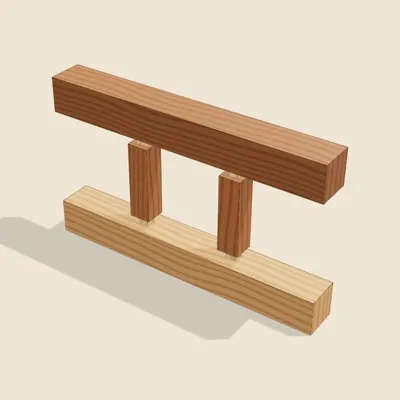
Under many Ming tables and stools, a stretcher runs a little below the top, joined to it by a row of short vertical pieces.
These are ailao, “short old men”, and each is tenoned at both ends.
- Chinese
- 矮老 · ǎilǎo
- Also called
- 短柱
- Joins
- Stretcher to the apron or top above
- Found in
- Tables and stools with stretchers below the top; high waists
- Signature parts
- Short strut · tenon at each end
How it works
Short struts
Ailao are short vertical members set between two horizontal members, such as a stretcher and the top frame or apron above it.
Tenons at both ends
Each strut is tenoned at both ends into mortises in the members above and below.
In high waists
Wang Shixiang’s drawings show a high waist divided by ailao, with panels (绦环板) set in the spaces between them.
A wedged variant
A source on Qing furniture names the ailao under drawer tables as the ideal place for a blind split-head wedge, because they hang and carry load.
How it's made
 Step 1
A gap
Two horizontal members with a gap between.
 Step 2
Struts
Short struts fill it.
 Step 3
Tenons
A tenon at each end.
 Step 4
Into the lower member
Into mortises in the lower member.
 Step 5
Upper member
The upper member comes down on top.
 Step 6
Panels
The spaces can take panels.
Variations
High waist with panels
Ailao divide a tall waist into sections fitted with panels.
Wedged blind tenons
Under drawer tables the tenons may be locked with blind split-head wedges.
Can you CNC this?
Yes, with small changes
The mortises are cut straight into the faces of the stretcher and the member above; round their corners. The tenons on the short struts may need the struts clamped upright, or a router table.
General note: a round cutter cannot leave a sharp inside corner, so every recess keeps the tool radius. Round the mating edges or add dogbone reliefs. Sloping faces, undercuts and curves may need special bits, extra setups or more axes.
Free STL downloads (one file per part)
- Stretcher 枨子 · ai-lao-stretcher.stl
- Short struts (2) 矮老(2 根) · ai-lao-struts.stl
- Upper member 上方构件 · ai-lao-upper-member.stl
Proportions are illustrative, not measured dimensions. The files are unitless: scale them to suit and check fits and allowances before cutting. Each file is a closed (watertight) solid with its mortises and slots already cut, exported in its assembled position, ready to import into CAM or modelling software. Licence: CC BY 4.0 (credit: Chinese Joinery).
Related joints
Staggered Stretchers
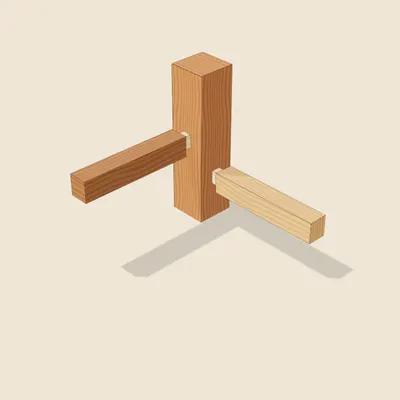
gǎn chéngStretchers from the front and side meet a leg at different heights, so their mortises never weaken it at one spot.
Loose Tenon
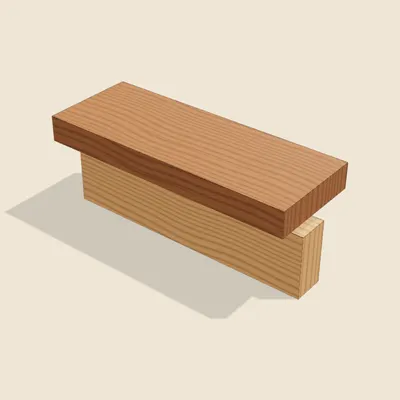
zāi xiāoThe tenon is a separate piece of wood planted into mortises in both parts, easy to replace if it wears.
Wedged Through Tenon
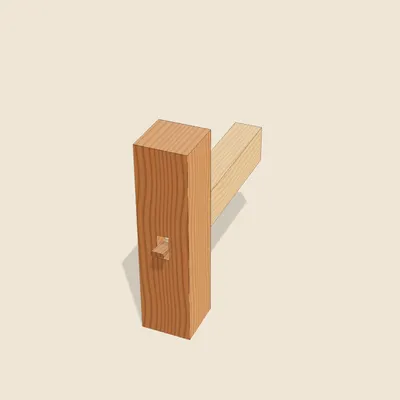
pòtóu xiēA kerf is sawn into the end of a through tenon; once the tenon is in, a wedge is driven in and spreads it tight.
Questions
What are ailao?
Short vertical struts between two horizontal members, tenoned at both ends.
Where are they found?
Between stretchers and tops of tables and stools, and in high waists.
Why the name?
矮老 literally means “short old man”.