Bawang Cheng (霸王枨): The Giant’s-Arm Brace of Ming Tables
Bawang cheng · Hook-and-wedge brace
A table needs bracing, but stretchers between the legs get in the way of knees and spoil a slender outline. Ming makers had an answer: tuck the bracing up out of sight.
The bawang cheng, the giant’s-arm brace, curves from the inside of each leg up to the underside of the top. Its name pictures a strong arm raised to hold up the sky.
- Chinese
- 霸王枨 · bàwáng chéng
- Joins
- Leg to the batten under the top
- Found in
- Square tables, stools, long tables
- Signature parts
- S-curved brace · hooked dovetail tenon · wedge · pin
- Replaces
- Stretchers between the legs
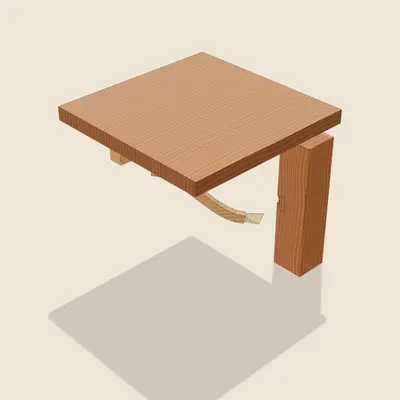
How it works
An S-shaped arm
The brace starts on the inside corner of the leg, roughly where a stretcher would go, and sweeps up in an S curve to a batten (穿带) under the top. There it is fixed with a wooden pin.
The hook
The lower end carries a tenon shaped like half a dovetail, hooking upward. The mortise in the leg is wide below and narrow above. The tenon goes in through the wide lower part and is pushed up, so it hooks behind the narrow upper part.
The wedge
That leaves a gap underneath. A wooden wedge driven into it stops the tenon dropping back, and the brace can’t be pulled out.
How it's made
 Step 1
Shape the brace
Cut the brace to an S curve.
 Step 2
Cut the hooked tenon
Form the lower tenon as half a dovetail, hooking upward.
 Step 3
Mortise the leg
Cut a mortise in the inner corner of the leg, wide at the bottom and narrow at the top.
 Step 4
Hook it in and wedge it
Insert the tenon through the wide part, push it up to hook, and drive a wedge into the gap below.
 Step 5
Pin the top end
Fix the top of the brace to the batten under the top with a wooden pin.
 Step 6
Clear legroom
The table is braced with nothing between the legs.
Variations
Square tables and stools
The classic use: four braces, one per leg.
Long tables
Also found on long tables with slender legs.
Can you CNC this?
Possible, with design or setup changes
If the S-curve lies in one plane, the brace can be profiled from a flat board. The hook on its lower end and the mortise in the leg are cut from the side and need rounded corners. The wedge is simple. A brace that also curves sideways would need 3D surfacing or hand work.
General note: a round cutter cannot leave a sharp inside corner, so every recess keeps the tool radius. Round the mating edges or add dogbone reliefs. Sloping faces, undercuts and curves may need special bits, extra setups or more axes.
Free STL downloads (one file per part)
- Leg 腿足 · bawang-cheng-leg.stl
- S-curved brace 霸王枨 · bawang-cheng-brace.stl
- Wedge 楔子 · bawang-cheng-wedge.stl
- Pin 销钉 · bawang-cheng-pin.stl
- Top with batten 面板与穿带 · bawang-cheng-top-with-batten.stl
Proportions are illustrative, not measured dimensions. The files are unitless: scale them to suit and check fits and allowances before cutting. Each file is a closed (watertight) solid with its mortises and slots already cut, exported in its assembled position, ready to import into CAM or modelling software. Licence: CC BY 4.0 (credit: Chinese Joinery).
Related joints
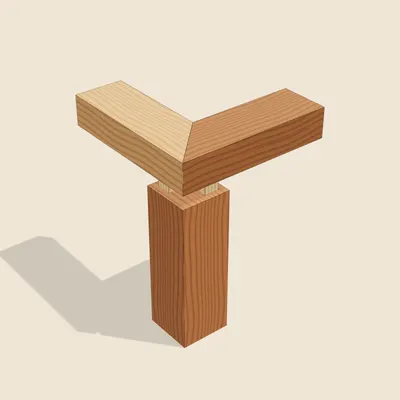
Long-and-Short Tenons
chángduǎn sǔnTwo tenons at right angles on the top of a leg: a long one for the long side, a short one for the end.
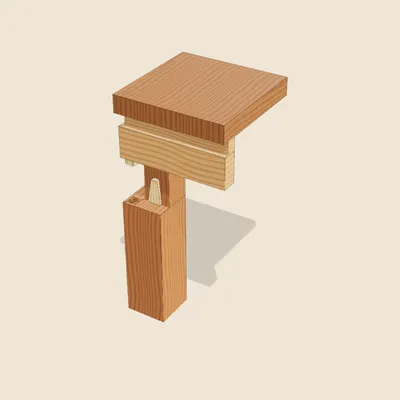
Baojian Joint
bàojiān sǔnThe hidden lock behind every waisted Ming table corner: a mitred shoulder, a triangular tenon and a tapered pin.
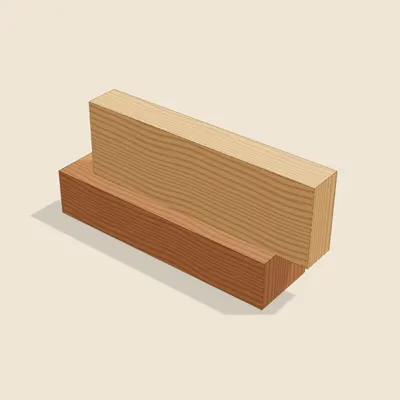
Sliding Locking Key
zǒumǎ xiāoA dovetailed key planted in one part drops into the wide end of a slot and slides to the narrow end to lock.
Questions
What is a giant’s-arm brace?
An S-curved brace on Ming tables that runs from the inside of each leg to a batten under the top, replacing stretchers between the legs.
How is the lower end fixed?
With a hooked tenon: a half-dovetail pushed up into a mortise that is wide below and narrow above, then locked with a wedge.
Why is it called bawang?
Bawang means an overlord or strongman. The brace looks like a powerful arm raised to hold up the top.