Gejiao Sun (格角榫): The Mitred Frame Corner
Mitred mortise-and-tenon · 攒边格角
Nearly every Chinese tabletop, door and cabinet side is a frame with a thin panel floating inside. Look at a corner of that frame and you see only a single diagonal line.
That line is the mitred frame joint, 格角榫. It hides end grain on every face, locks the corner square, and gives the panel a groove to sit in.
- Chinese
- 格角榫 · géjiǎo sǔn
- Joins
- Long side (大边) to end (抹头)
- Found in
- Tabletops, chair seats, door and cabinet panels
- Signature parts
- 45° mitre · tenon on the long side · small triangular tongue
- Goes with
- Frame-and-panel (攒边打槽装板)
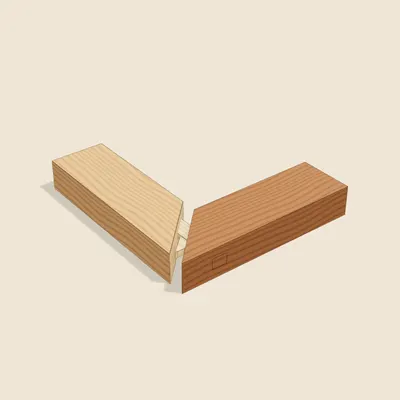
How it works
Long sides and ends
The two long members of the frame are the 大边; they carry the tenons. The two short ones are the 抹头; they take the mortises, often cut right through.
Two mitres and a tongue
Where they meet, both members are cut at 45°, so the corner shows only a diagonal seam. Beside the main tenon a small triangular tongue is left at the mitre. It can be hidden (闷) or allowed to show (明).
Why a frame at all
The frame’s inner edge is grooved, and a thin panel with a tongue all round sits in the groove. Battens slide across the underside and tenon into the long sides. Thin boards then do the work of a thick slab, the ugly end grain disappears, and the panel can still move with the seasons.
How it's made
 Step 1
Cut the mitres
Mark and cut 45° mitres at the ends of the long side and the end.
 Step 2
Cut the tenon
Leave a tenon on the long side, projecting beyond the mitre.
 Step 3
Cut the mortise
Cut the matching mortise in the end, usually right through.
 Step 4
Leave the small tongue
Form the small triangular tongue at the mitre, hidden or showing.
 Step 5
Push the end on
Slide the end onto the tenon until the mitres close.
 Step 6
Groove for the panel
Cut a groove round the inner edge to take the panel’s tongue.
Variations
Hidden tongue
The triangular tongue stays inside the joint and doesn’t show.
Showing tongue
The tongue comes through to the surface as a small triangle.
Woven seats
On chairs and beds with woven rattan seats, the frame is mitred the same way and drilled for the weave.
Can you CNC this?
Yes, with small changes
With the frame members flat, the 45° mitre, the tenon and the small triangular tongue are all cut from above. The tongue’s socket and the mortise get rounded inside corners; dogbones or rounded tenon edges may be needed.
General note: a round cutter cannot leave a sharp inside corner, so every recess keeps the tool radius. Round the mating edges or add dogbone reliefs. Sloping faces, undercuts and curves may need special bits, extra setups or more axes.
Free STL downloads (one file per part)
Proportions are illustrative, not measured dimensions. The files are unitless: scale them to suit and check fits and allowances before cutting. Each file is a closed (watertight) solid with its mortises and slots already cut, exported in its assembled position, ready to import into CAM or modelling software. Licence: CC BY 4.0 (credit: Chinese Joinery).
In museum collections
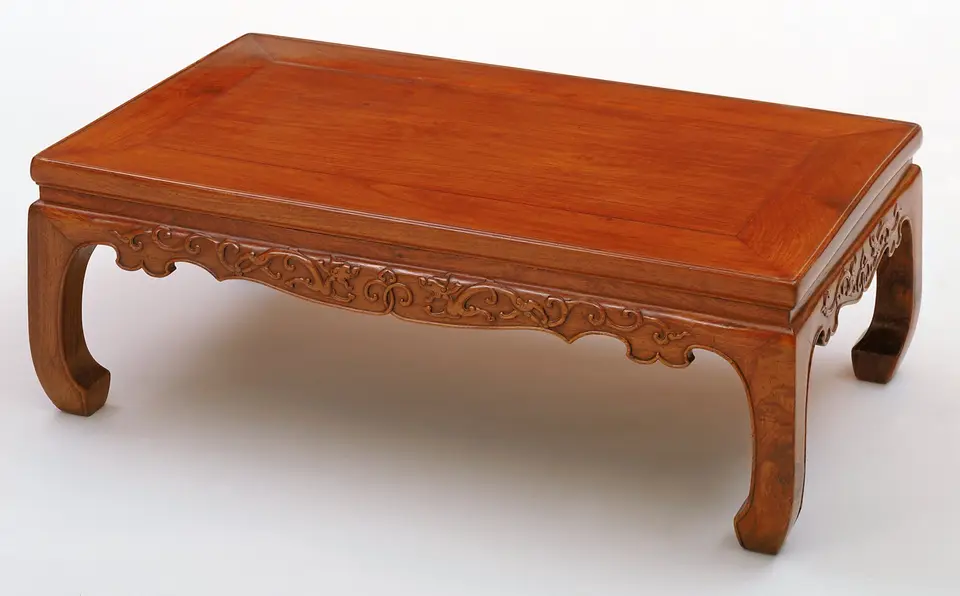
Minneapolis Institute of Art
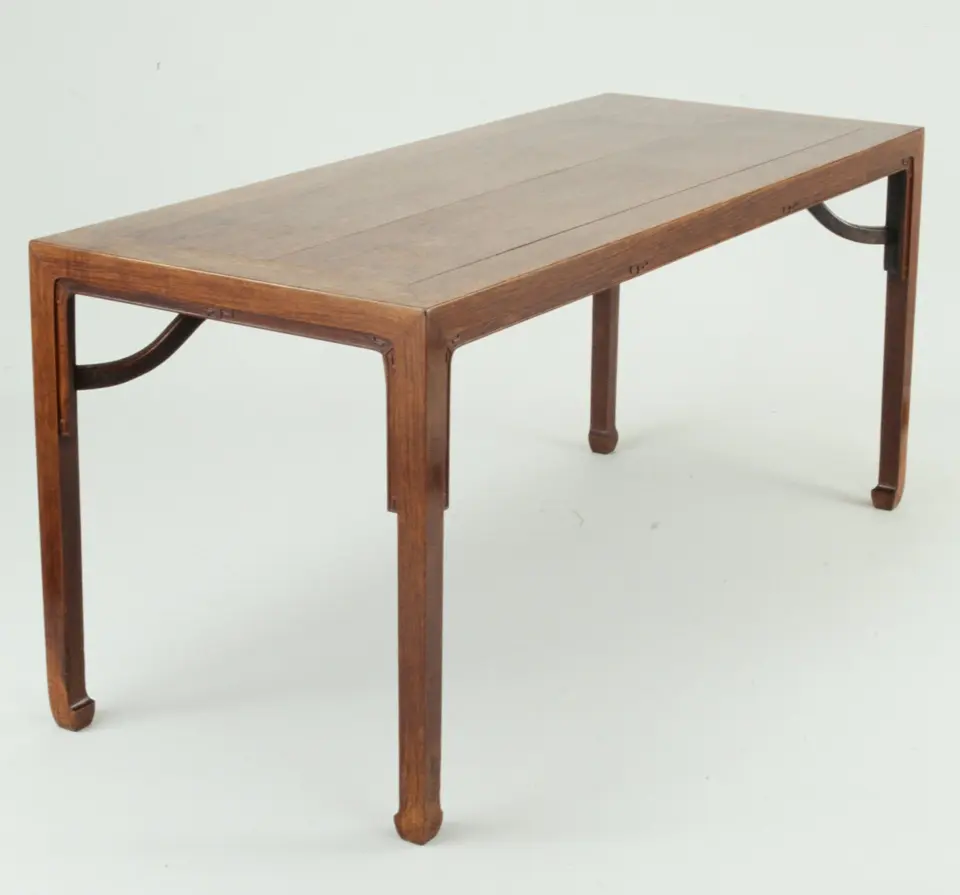
Minneapolis Institute of Art
Related joints
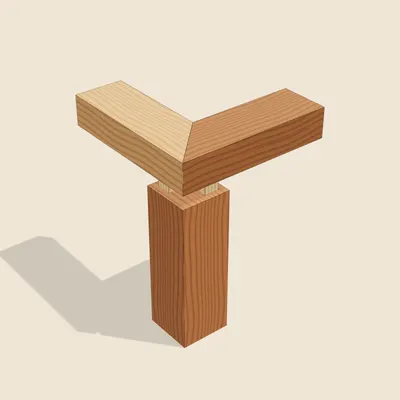
Long-and-Short Tenons
chángduǎn sǔnTwo tenons at right angles on the top of a leg: a long one for the long side, a short one for the end.
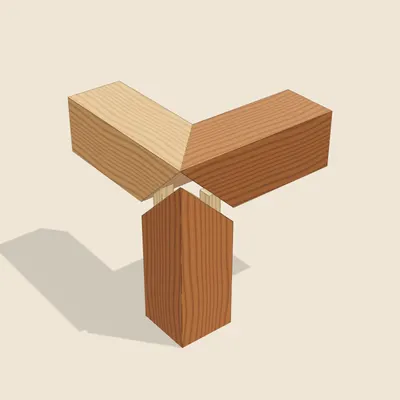
Zongjiao Joint
zòngjiǎo sǔnThree members, three 45° mitres, one perfect point: the corner joint of flush-sided tables and cabinets.
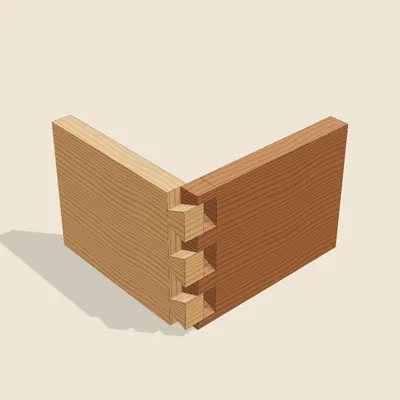
Dovetail Joint
yànwěi sǔnA tenon wider at the tip than at the root, so it can’t pull out: found in boxes, drawers, tables and temple beams.
Questions
What is a gejiao joint?
The mitred mortise-and-tenon corner of a Chinese frame: the long side carries a tenon into the end, both are cut at 45°, and a small triangular tongue sits at the mitre.
Why mitre the corner?
A mitre hides the end grain on both visible faces and lets mouldings run round the corner unbroken.
Why is there a groove?
The frame holds a floating panel. Its tongue sits in the groove, so the panel can expand and shrink without cracking.
Further reading
- 明式家具研究榫卯篇:格角榫攒边, 搜狐
- 文化知识 (excerpts from Wang Shixiang, 明式家具珍赏), 北京中国紫檀博物馆
- 边框与板结构, chinese-furniture.com
- Wang Shixiang, 家具结构之结合: 基本接合 (excerpt), 中国文物网
- 王世襄手绘榫卯结构 85 种 (list), 美篇
- Ganeshan et al., MiGumi: Making Tightly Coupled Integral Joints Millable (SIGGRAPH Asia 2025)
- Jochen Gros & Friedrich Sulzer (HfG Offenbach), 50 Digital Wood Joints