Cabinet Stretchers That Give Way (两枨互让)
Mutually yielding stretchers · 柜子底枨
At the foot of a Chinese cabinet, the front and side bottom stretchers meet each leg at exactly the same height. Two full tenons there would hollow the leg out.
So the two tenons give way to each other.
- Chinese
- 柜子底枨两枨互让 · liǎng chéng hù ràng
- Joins
- Front and side bottom stretchers to a cabinet leg
- Found in
- Cabinets
- Signature parts
- Two “big-in, small-out” tenons, one through above, one through below
- Related
- Big-in, small-out tenon
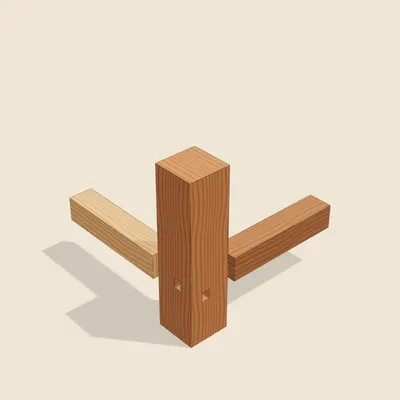
How it works
Same height
Wang Shixiang notes that the front and side bottom stretchers of a cabinet meet the leg at the same height.
Big in, small out
A common way to make room: both tenons are “big in, small out”. The side stretcher’s tenon has its lower half cut short, so its upper half becomes a through tenon; the front stretcher’s has its upper half cut short, so its lower half goes through.
Why
Because the two tenons give way to each other, the leg is not cut away too much, and both the front and the side still get the stronger through tenon.
How it's made
 Step 1
Same height
Two stretchers at the same height.
 Step 2
Front tenon
Upper half cut short; lower half goes through.
 Step 3
Side tenon
Lower half cut short; upper half goes through.
 Step 4
Front in
Fit the front stretcher.
 Step 5
Side in
The side stretcher passes above it.
 Step 6
Both through
Both through, leg not over-cut.
Variations
Using the apron
Another way: the front stretcher has a through tenon and the side stretcher a blind one, while the apron under the side stretcher has through tenons at both ends. Its smaller tenon ends are allowed to show on the front instead of the stretcher’s.
Can you CNC this?
Yes, with small changes
All four mortise sections are cut straight into two faces of the leg, which suits a 3-axis machine with the leg turned once. The stepped tenons are cut on the stretcher ends and may need the stretchers clamped upright or a router table. Round the inside corners.
General note: a round cutter cannot leave a sharp inside corner, so every recess keeps the tool radius. Round the mating edges or add dogbone reliefs. Sloping faces, undercuts and curves may need special bits, extra setups or more axes.
Free STL downloads (one file per part)
- Leg 腿足 · liangcheng-hurang-leg.stl
- Front bottom stretcher 正面底枨 · liangcheng-hurang-stretcher-front.stl
- Side bottom stretcher 侧面底枨 · liangcheng-hurang-stretcher-side.stl
Proportions are illustrative, not measured dimensions. The files are unitless: scale them to suit and check fits and allowances before cutting. Each file is a closed (watertight) solid with its mortises and slots already cut, exported in its assembled position, ready to import into CAM or modelling software. Licence: CC BY 4.0 (credit: Chinese Joinery).
Related joints
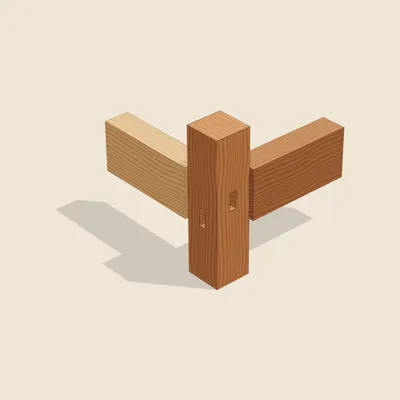
Big-In, Small-Out Tenon
dàjìn xiǎochū sǔnPart blind, part through: a big tenon enters, a small one shows. It lets two stretchers share a leg without weakening it.
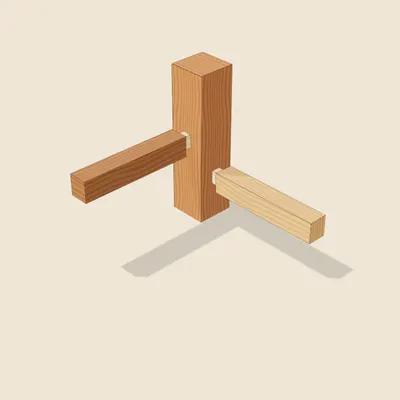
Staggered Stretchers
gǎn chéngStretchers from the front and side meet a leg at different heights, so their mortises never weaken it at one spot.
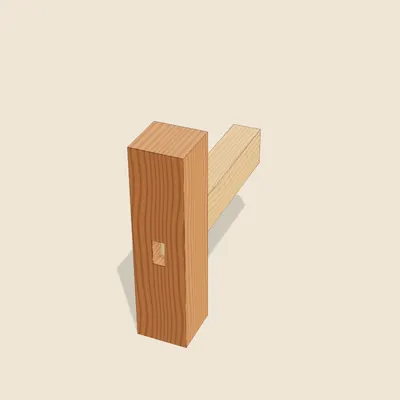
Through Tenon
tòu sǔnThe tenon runs right through and its end grain shows on the far side: strong, but less neat than a blind tenon.
Questions
What does 两枨互让 mean?
Two stretchers whose tenons give way to each other inside the leg.
Why not two full tenons?
They would cut too much out of the leg at one height.
Do both show?
Yes: each keeps a through half, one above and one below.