Qi Jianbang (齐肩膀): The Square-Shouldered T-Joint
Butt shoulder · 齐头碰
Most fine Chinese T-joints carry a little mitre on the shoulder, so the moulding turns the corner.
The square shoulder skips the mitre. Whether that is acceptable depends on where it is used.
- Chinese
- 齐肩膀 · qí jiānbǎng
- Also called
- 齐头碰
- Joins
- Rail to leg or post
- Found in
- Rails set back from the leg; backs and sides of plainer chairs
- Compare
- Mitred shoulder (格肩榫)
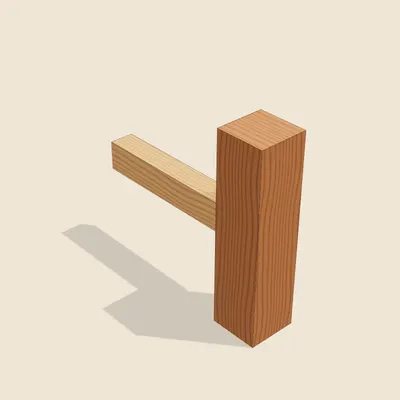
How it works
No mitre
The shoulder is cut straight across and the tenon goes into the leg. Wang Shixiang gives it the shop name “butting heads” (齐头碰).
Where it is fine
It is used where rail and leg sit one behind the other and do not run flush, or where a leg that is round outside meets an oval stretcher and the faces cannot run on anyway.
Where it looks rough
If both members are square and in one flat face, only rough furniture leaves out the mitre. Wang notes that fine chairs use mitred shoulders on all four sides, plainer ones on the front only, and the roughest use square shoulders everywhere.
How it's made
 Step 1
A T-joint
A rail meets a leg.
 Step 2
Straight shoulder
Cut the shoulder straight across.
 Step 3
Plain tenon
Cut a plain tenon.
 Step 4
Set back
The rail sits back from the leg face.
 Step 5
Fine here
Fine where the faces are not flush.
 Step 6
Rough on flush faces
On flush faces it looks rough.
Variations
Mitred shoulder
The usual joint where faces run flush.
Can you CNC this?
Yes, with small changes
The simplest T-joint to machine: a straight mortise from the face and a plain tenon. Round the mortise ends or the tenon edges.
General note: a round cutter cannot leave a sharp inside corner, so every recess keeps the tool radius. Round the mating edges or add dogbone reliefs. Sloping faces, undercuts and curves may need special bits, extra setups or more axes.
Free STL downloads (one file per part)
Proportions are illustrative, not measured dimensions. The files are unitless: scale them to suit and check fits and allowances before cutting. Each file is a closed (watertight) solid with its mortises and slots already cut, exported in its assembled position, ready to import into CAM or modelling software. Licence: CC BY 4.0 (credit: Chinese Joinery).
Related joints
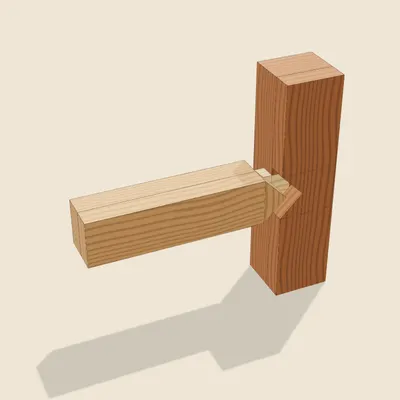
Mitred-Shoulder Joint
géjiān sǔnWhere a rail meets a post, its outer face is cut to a point that fits a matching notch, so mouldings meet cleanly.
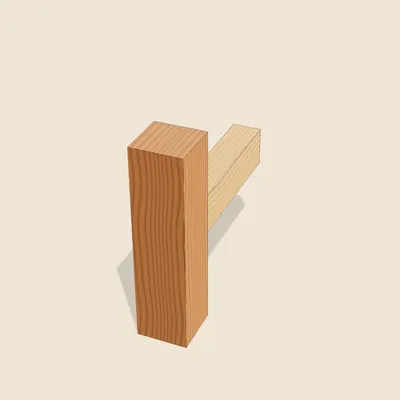
Blind Tenon
bàn sǔnThe tenon stops inside the post, so nothing shows on the outside: neat, a little less strong than a through tenon.
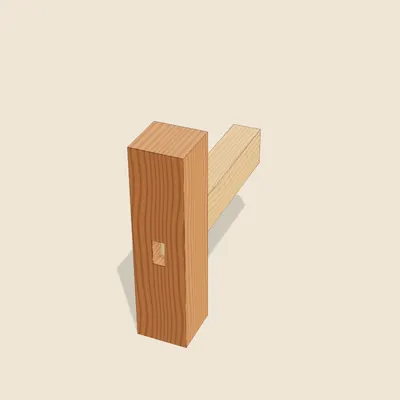
Through Tenon
tòu sǔnThe tenon runs right through and its end grain shows on the far side: strong, but less neat than a blind tenon.
Questions
What is a square shoulder?
A T-joint with a straight shoulder and no mitre.
Is it a poor joint?
It is fine where faces are not flush; on flush faces it marks plainer work.
Where do fine chairs use it?
Wang says fine chairs use mitred shoulders on all four sides.