Tanglang Tou (螳螂头): The Mantis-Head Splice
Mantis-head tenon · 螳螂头榫 · 螳螂頭口
A long building needs purlins and plates longer than any tree. They are made in lengths that meet over the columns.
The Song building manual Yingzao Fashi (1103) draws the joint used at those seams: the mantis head.
- Chinese
- 螳螂头口 · tángláng tóu kǒu
- Also called
- 螳螂头榫
- Joins
- Purlins (槫) or plates (普拍方) end to end
- Found in
- Song to Ming timber buildings
- Signature parts
- Narrow neck · wide head · matching socket
- Compare
- Butterfly key
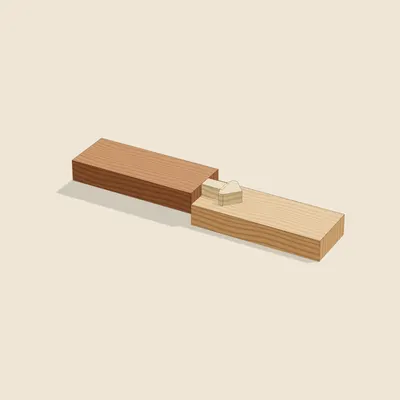
How it works
In the Song manual
Chapter 30 of the Yingzao Fashi, “Mortises of beams and lintels”, draws three seams where members meet end to end: the purlin seam with a mantis-head joint (槫間縫螳螂頭口), the plate seam with a mantis-head joint (普拍方間縫螳螂頭口), and the plate seam with a hooked lap (勾頭搭掌). The drawings show one member ending in a narrow neck and a wider, pointed head, and the other cut with a socket of the same shape.
Head and neck
A Chinese conservation builder’s guide describes the mantis-head tenon as common in large Ming buildings, for joining purlins end to end and for the plates over the columns. It gives the head and the neck as each half the length of the tenon.
Why it holds
Because the head is wider than the neck, the joint resists being pulled apart along its length, like a dovetail. The tenon runs through the full depth, so the second member is simply dropped in from above, and the seam then sits on the column and its bracket.
Proportions in the model are illustrative.
How it's made
 Step 1
End to end
Two plates meet end to end over a column.
 Step 2
Neck
One end is cut to a narrow neck.
 Step 3
Head
Beyond it, a wide pointed head.
 Step 4
Socket
A matching socket in the other end.
 Step 5
Drop in
The head is dropped in from above.
 Step 6
Locked
The head cannot pull out.
Variations
Purlin seam
On round purlins the same head and neck are cut on the purlin end (槫間縫螳螂頭口).
Hooked lap
For plates the manual also shows a hooked lap (勾頭搭掌).
Can you CNC this?
Yes, with small changes
Straightforward on a 3-axis machine: the head and neck are cut right through the depth, so both the tenon and the socket are plain 2D profiles. The socket needs a small cutter or hand-squared inside corners where the head meets the neck.
General note: a round cutter cannot leave a sharp inside corner, so every recess keeps the tool radius. Round the mating edges or add dogbone reliefs. Sloping faces, undercuts and curves may need special bits, extra setups or more axes.
Free STL downloads (one file per part)
- Plate with socket 开卯口的普拍方 · tanglang-tou-plate-with-socket.stl
- Plate with mantis-head tenon 出螳螂头的普拍方 · tanglang-tou-plate-with-mantis-head.stl
Proportions are illustrative, not measured dimensions. The files are unitless: scale them to suit and check fits and allowances before cutting. Each file is a closed (watertight) solid with its mortises and slots already cut, exported in its assembled position, ready to import into CAM or modelling software. Licence: CC BY 4.0 (credit: Chinese Joinery).
Related joints
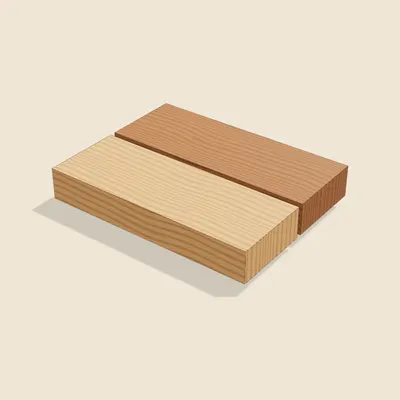
Butterfly Key
yíndìng sǔnA bow-tie key, two dovetails back to back, let in across a seam to lock thick boards together.
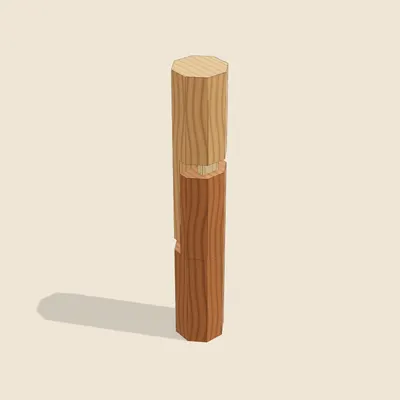
Palm Splice
bāzhang sǔnOld column and new foot are each cut to a half-thickness “palm”; the palms overlap, short tenons lock their ends, and iron hoops bind it.
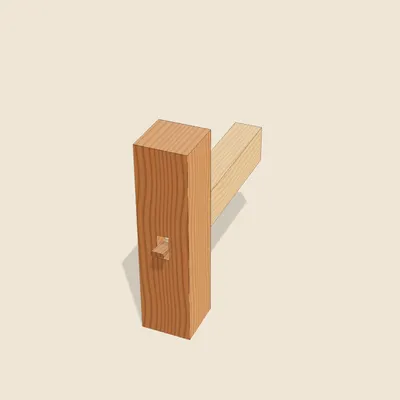
Wedged Through Tenon
pòtóu xiēA kerf is sawn into the end of a through tenon; once the tenon is in, a wedge is driven in and spreads it tight.
Questions
Why “mantis head”?
The wide head on a thin neck looks like a mantis’s head.
Where is it used?
Where purlins or plates meet end to end over a column.
How is it assembled?
The head is cut through the full depth and dropped in from above.