Chuandai (穿带): The Batten That Keeps Tops Flat
Chuandai · Dovetailed batten
Turn an old Chinese table over and you will find one or more bars running across the underside of the top. They aren’t nailed or screwed. They are slid in.
Each is a chuandai, a sliding dovetail batten. It holds a thin panel flat for centuries while still letting it swell and shrink with the seasons.
- Chinese
- 穿带 · chuāndài
- Joins
- Battens to the back of a panel, and into the frame
- Found in
- Tabletops, cabinet doors and sides; door boards in buildings
- Signature parts
- Dovetail housing · tapered batten · tenon ends
- Works with
- Longfeng board joints, mitred frames
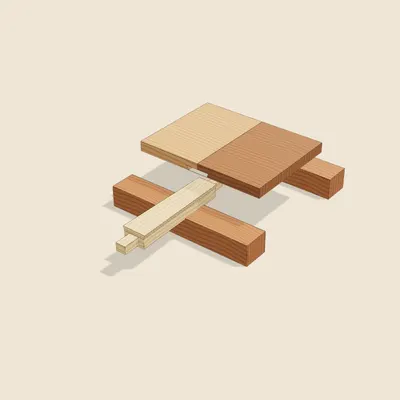
How it works
A dovetail across the grain
A dovetail-section housing (带口) is cut across the back of the panel, and the batten has a matching trapezoid tongue. Slid in, the batten can’t drop out, and it stops the boards from cupping.
Why it tapers
Both housing and batten are slightly wider at one end, which craftsmen call 出梢. Driven in from the wide end, the batten tightens as it goes. Wang Shixiang warns that too much taper lets the batten creep back, and too little lets it slide straight through.
Into the frame
The ends of the batten are left long as tenons and go into mortises in the long sides of the frame, so the panel is held in the frame too.
How it's made
 Step 1
Cut the housing
Cut a dovetail housing across the back of the panel, slightly wider at one end.
 Step 2
Shape the batten
Plane the batten to a matching trapezoid tongue, tapered the same way.
 Step 3
Leave tenon ends
Leave the ends of the batten long as tenons.
 Step 4
Drive it in
Slide the batten in from the wide end until it is tight.
Tip Too much taper and it creeps back; too little and it slides through.
 Step 5
Into the frame
The tenon ends go into mortises in the long sides of the frame.
 Step 6
Check
The panel lies flat but isn’t glued across its width.
Variations
How many battens
Wang suggests the outer battens about 15 cm from each end of the panel and roughly one every 40 cm between.
Hard and soft battens in buildings
Builders distinguish battens that stand proud of a door board from ones planed flush, and drive tapered battens from opposite sides.
Can you CNC this?
Possible, with design or setup changes
A tapered sliding dovetail can be cut with a dovetail bit: the groove across the panel is cut from the face and the taper is a change in width in plan, which a 3-axis machine handles. The batten’s dovetail edges may need the part on its side or the same dovetail bit from above. The fit is usually tuned by trial.
General note: a round cutter cannot leave a sharp inside corner, so every recess keeps the tool radius. Round the mating edges or add dogbone reliefs. Sloping faces, undercuts and curves may need special bits, extra setups or more axes.
Free STL downloads (one file per part)
- Panel (two boards) 面板(两块拼板) · chuandai-panel.stl
- Batten 穿带 · chuandai-batten.stl
- Frame sides 边框两侧 · chuandai-frame-sides.stl
Proportions are illustrative, not measured dimensions. The files are unitless: scale them to suit and check fits and allowances before cutting. Each file is a closed (watertight) solid with its mortises and slots already cut, exported in its assembled position, ready to import into CAM or modelling software. Licence: CC BY 4.0 (credit: Chinese Joinery).
Related joints
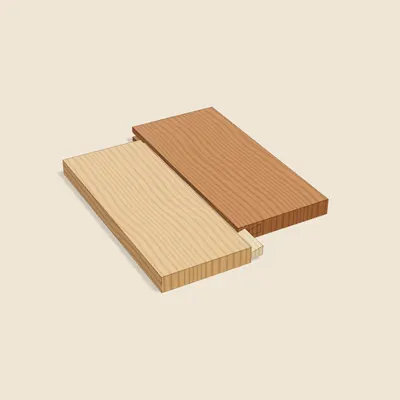
Longfeng Board Joint
lóngfèng sǔnA half-dovetail tongue on one board slides into a matching groove in the next, so the seam can neither step nor pull apart.
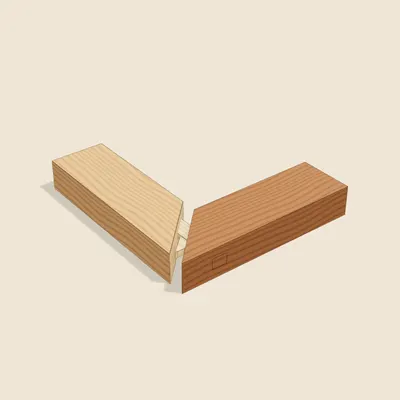
Mitred Frame Joint
géjiǎo sǔnThe 45° corner of every Chinese frame-and-panel top: a tenon through the end plus a little triangular tongue.
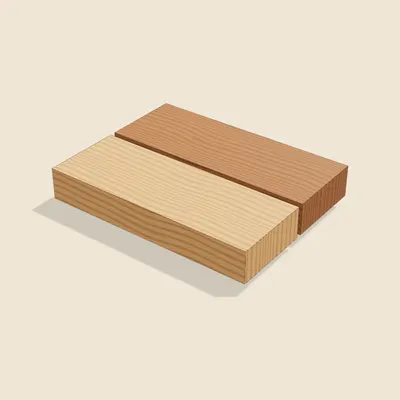
Butterfly Key
yíndìng sǔnA bow-tie key, two dovetails back to back, let in across a seam to lock thick boards together.
Questions
What is a chuandai?
A tapered dovetail batten slid across the back of a Chinese panel to keep it flat; its ends tenon into the frame.
Why is it tapered?
So it tightens as it is driven in. Wang Shixiang notes the taper must be just right: too much and it backs out, too little and it slides through.
Is it glued?
The batten works by its dovetail fit, so the panel can still move with the seasons.
Further reading
- Wang Shixiang, 家具结构之结合: 基本接合 (excerpt), 中国文物网
- 文化知识 (excerpts from Wang Shixiang, 明式家具珍赏), 北京中国紫檀博物馆
- 边框与板结构, chinese-furniture.com
- 传统大木结构中的榫卯, 汉匠
- Ganeshan et al., MiGumi: Making Tightly Coupled Integral Joints Millable (SIGGRAPH Asia 2025)
- Jochen Gros & Friedrich Sulzer (HfG Offenbach), 50 Digital Wood Joints