Hidden Mitred Corner With a Loose Block (方材闷榫)
Loose-block mitre · 闷榫角接合
A mitred corner hides end grain, but a bare mitre has little to hold it.
One hidden way to strengthen it is a loose block set into both mitre faces.
- Chinese
- 方材闷榫角接合 · fāngcái mènsǔn jiǎo jiēhé
- Joins
- Two square members at a right-angle corner
- Found in
- Frame corners where nothing should show
- Signature parts
- Two 45° faces · two sockets · loose block
- Compare
- Mitred frame tenon
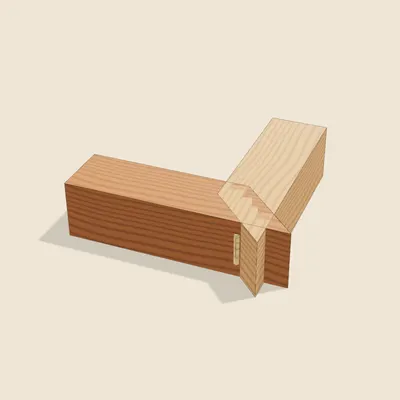
How it works
Two mitres
An article on Ming furniture joinery describes a hidden way to join straight members at a corner: both members are cut to a 45° face.
A loose block
A socket is cut into each mitre face and a rectangular block is set into both sockets and glued.
Other versions
Wang Shixiang’s drawings also show a hidden corner of square members where each member carries its own single tenon; the loose-block version shown here is one way to keep both members simple.
How it's made
 Step 1
A corner
Two members meet at a corner.
 Step 2
45°
Cut both to 45°.
 Step 3
Sockets
A socket in each mitre face.
 Step 4
Block
Make a rectangular block.
 Step 5
Glue
Glue the block into both.
 Step 6
Hidden
Only a mitre line shows.
Variations
Single tenons
Each member carries its own single tenon (Wang’s drawing “各出单榫”).
Can you CNC this?
Possible, with design or setup changes
The 45° faces can be cut with the parts flat, but the sockets go into a sloping face, which may need a tilted fixture or the part clamped at 45°. A loose-tenon jointer may be easier than a 3-axis machine.
General note: a round cutter cannot leave a sharp inside corner, so every recess keeps the tool radius. Round the mating edges or add dogbone reliefs. Sloping faces, undercuts and curves may need special bits, extra setups or more axes.
Free STL downloads (one file per part)
- Rail 横材 · fangcai-mensun-rail.stl
- Loose block 长方木块 · fangcai-mensun-loose-block.stl
- Post 竖材 · fangcai-mensun-post.stl
Proportions are illustrative, not measured dimensions. The files are unitless: scale them to suit and check fits and allowances before cutting. Each file is a closed (watertight) solid with its mortises and slots already cut, exported in its assembled position, ready to import into CAM or modelling software. Licence: CC BY 4.0 (credit: Chinese Joinery).
Related joints
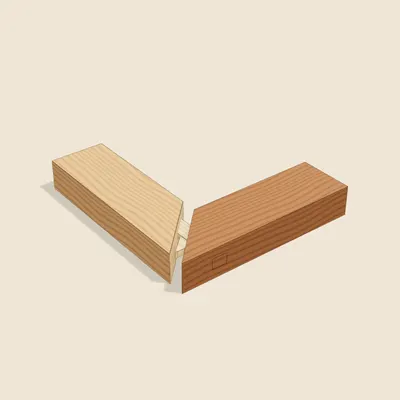
Mitred Frame Joint
géjiǎo sǔnThe 45° corner of every Chinese frame-and-panel top: a tenon through the end plus a little triangular tongue.
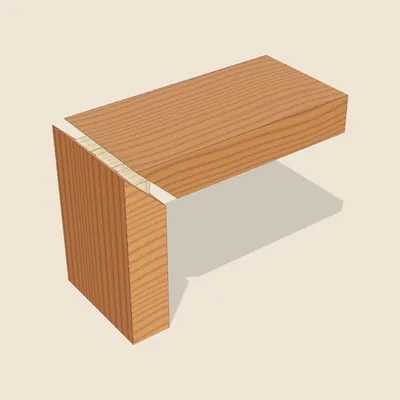
Hidden Mitred Dovetail
mèn sǔnDovetails hidden inside a mitred corner: once closed, only a single seam line shows.
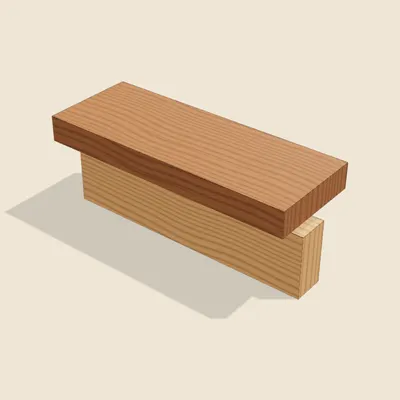
Loose Tenon
zāi xiāoThe tenon is a separate piece of wood planted into mortises in both parts, easy to replace if it wears.
Questions
What is this joint?
A hidden mitre held by a loose block in both faces.
Is it glued?
Yes, the source says the block is glued.
Where is it used?
Corners where nothing should show.