Tuoni (托泥): How Legs Lock Into a Base Frame
Base frame · 托泥
Some Chinese tables, stands and stools do not stand on their feet directly. The feet sit on a low frame on the floor, the tuoni.
The frame does more than lift the feet off a damp floor: it locks them.
- Chinese
- 托泥 · tuōní
- Joins
- Feet to a base frame
- Found in
- Waisted tables, stands, stools and thrones
- Signature parts
- Mitred frame · socket wide at the bottom · foot tenon
- Related
- Waisted corner (抱肩榫)
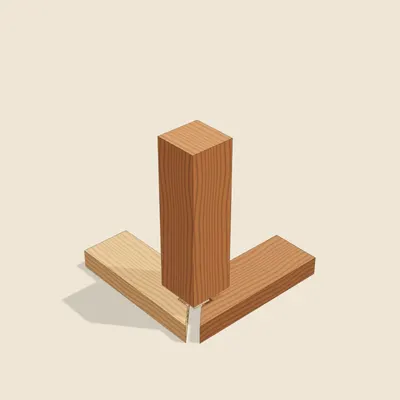
How it works
Why a base frame
An article on Ming furniture joinery explains that waisted pieces mostly use the waisted corner joint, whose apron supports but does little to stop the legs splaying. A base frame or low stretchers make up for that. It also protects the piece: when the part touching the floor rots or wears, only the frame needs replacing.
Mitred frame, locked foot
A framed base is made of long sides and ends mitred at the corners. At the seam a socket is cut that is wide at the bottom and narrow at the mouth, and the foot ends in a matching tenon, usually cut from the leg itself. The frame is assembled around the tenons, so it cannot fall off when the piece is moved.
Later simplifications
In the Qing dynasty this was often reduced to a hole in frame and foot joined by a glued wooden peg, which works loose as the glue fails. Round base frames are made of curved pieces butted under each foot and pinned right through frame and leg.
How it's made
 Step 1
A frame
A frame under the feet.
 Step 2
Mitred
Sides and ends mitred at the corner.
 Step 3
Socket
A socket at the seam, wide at the bottom.
 Step 4
Foot tenon
A matching tenon on the foot.
 Step 5
Close the frame
Assemble the frame around the tenon.
 Step 6
Locked
It cannot fall off when moved.
Variations
Qing pegged version
Holes in frame and foot joined with a glued peg; it works loose in time.
Round base frames
Curved pieces butted under each foot, pinned through frame and leg.
Trestle tables
Just two cross pieces with sockets for the legs.
Can you CNC this?
Hard on a 3-axis machine as drawn
Hard as drawn: the socket is wider at the bottom than at the mouth, an undercut a straight 3-axis cutter cannot reach, and it is split across a mitred seam. A simpler version (a straight socket and a pegged or pinned foot) is easy to machine, but it loses the locking that makes this joint work.
General note: a round cutter cannot leave a sharp inside corner, so every recess keeps the tool radius. Round the mating edges or add dogbone reliefs. Sloping faces, undercuts and curves may need special bits, extra setups or more axes.
Free STL downloads (one file per part)
- Leg with foot tenon 带足下榫头的腿足 · tuoni-leg.stl
- Base frame long side 托泥边挺 · tuoni-base-frame-side.stl
- Base frame end 托泥抹头 · tuoni-base-frame-end.stl
Proportions are illustrative, not measured dimensions. The files are unitless: scale them to suit and check fits and allowances before cutting. Each file is a closed (watertight) solid with its mortises and slots already cut, exported in its assembled position, ready to import into CAM or modelling software. Licence: CC BY 4.0 (credit: Chinese Joinery).
Related joints
Baojian Joint
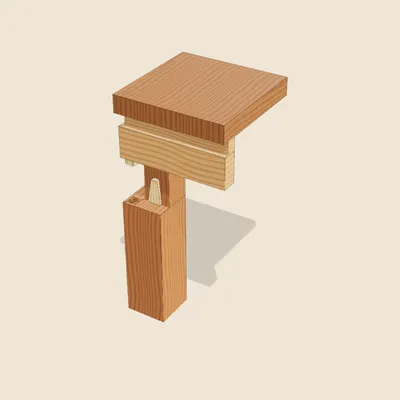
bàojiān sǔnThe hidden lock behind every waisted Ming table corner: a mitred shoulder, a triangular tenon and a tapered pin.
Mitred Frame Joint
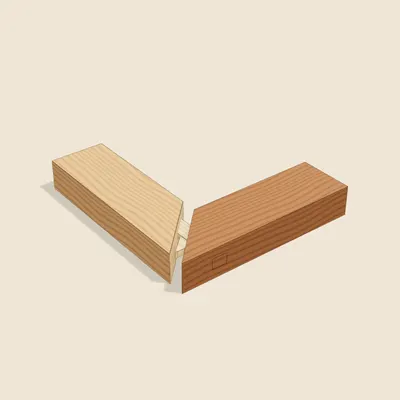
géjiǎo sǔnThe 45° corner of every Chinese frame-and-panel top: a tenon through the end plus a little triangular tongue.
Loose Tenon
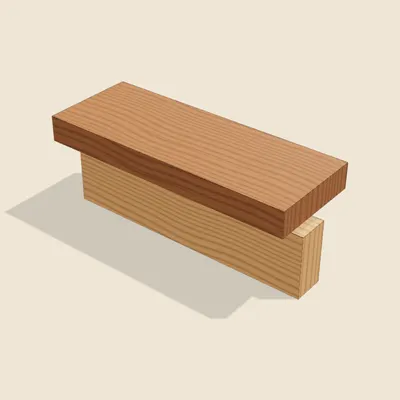
zāi xiāoThe tenon is a separate piece of wood planted into mortises in both parts, easy to replace if it wears.
Questions
What is a tuoni?
A low frame under the feet of a piece of furniture.
How are the feet held?
By tenons wide at the bottom in sockets cut at the frame’s mitred seams.
Why use one?
It keeps the legs from splaying and can be replaced when worn.